

KRTHA BHAYANGKARA is committed to upholding originality, academic integrity, and responsible scholarly communication in legal research and scholarship. Plagiarism, inappropriate text reuse, and other forms of intellectual misconduct undermine the credibility of legal scholarship and are not tolerated.
All manuscripts submitted to KRTHA BHAYANGKARA must constitute original scholarly work and appropriately acknowledge the sources of legal arguments, theories, concepts, statutory provisions, court decisions, research findings, data, and other materials used.
This policy applies to all manuscript categories published by the journal, including Original Research Articles and Theoretical and Conceptual Papers. It covers normative legal research, empirical legal research, socio-legal studies, comparative legal research, historical legal research, and other relevant approaches within the journal's Aims and Scope.
The policy is guided by the principles and recommendations of the Committee on Publication Ethics (COPE) and internationally recognized standards of responsible scholarly publishing.
All manuscripts submitted to KRTHA BHAYANGKARA undergo similarity screening using Turnitin or an equivalent text-matching tool to identify textual similarities with previously published works, academic publications, online sources, and other available materials.
The journal applies the following similarity thresholds:
Maximum Overall Similarity Index: 20%, excluding the bibliography, individual source matches below 1%, and properly cited direct quotations.
Maximum Single-Source Similarity: No individual source match should exceed 3%.
Manuscripts exceeding these thresholds may be returned to the authors for clarification or correction, or rejected, depending on the nature, extent, and context of the identified similarities.
The similarity index serves as an initial screening indicator rather than a definitive determination of plagiarism. The editorial team examines each similarity report by considering the sources, context, extent, and location of matching text, as well as the adequacy of citations and acknowledgments.
A similarity index below 20% does not automatically establish that a manuscript is free from plagiarism. Conversely, a score exceeding 20% does not automatically constitute an ethical violation. Editorial decisions rely on a contextual assessment of the similarity report, the originality of the manuscript, and the integrity of the scholarly work.
Particular attention is given to the appropriate attribution of legal doctrines, statutory interpretations, judicial decisions, legal arguments, and other scholarly contributions.
Plagiarism and related publication ethics violations may include, but are not limited to, the following:
Direct Plagiarism: Reproducing another author's words, sentences, paragraphs, or substantial portions of a scholarly work without appropriate quotation, citation, or acknowledgment.
Paraphrasing Plagiarism: Presenting another author's legal arguments, theoretical perspectives, interpretations, research findings, or ideas in different words without properly acknowledging the original source.
Intellectual and Research Data Appropriation: Using another researcher's data, empirical findings, legal analysis, tables, figures, research instruments, or other scholarly contributions without appropriate attribution or authorization, where required.
Legal Source Misappropriation: Using statutory interpretations, judicial reasoning, legal doctrines, legal opinions, or other legal arguments developed by another author without proper citation or acknowledgment.
Self-Plagiarism and Text Recycling: Reusing substantial portions of one's own previously published work without adequate citation, disclosure, or scholarly justification.
Duplicate or Redundant Publication: Submitting or publishing substantially overlapping manuscripts without appropriate disclosure or a sufficiently distinct scholarly contribution.
Unauthorized Use of Published Materials: Reproducing copyrighted texts, figures, tables, or other protected materials without obtaining permission where such permission is legally required.
Authors must ensure that all borrowed materials are appropriately acknowledged and that any reuse of previously published work is transparently disclosed to the editorial office.
Similarity reports are assessed contextually, including whether matching text consists of properly attributed quotations, bibliographic entries, standard legal terminology, statutory language, conventional methodological descriptions, or other legitimate forms of textual overlap.
Authors bear full responsibility for ensuring the originality, accuracy, and proper attribution of their manuscripts before submission to KRTHA BHAYANGKARA.
Authors are strongly encouraged to conduct preliminary similarity checks using plagiarism-detection software and address any inappropriate textual overlap before submitting their manuscripts.
Authors must:
Ensure that all arguments, ideas, theories, legal interpretations, and research findings derived from other sources receive appropriate acknowledgment.
Clearly distinguish direct quotations from the authors' own analysis and provide accurate citations.
Provide complete and accurate references for statutory provisions, court decisions, legal documents, academic publications, and other relevant sources.
Disclose substantial overlap with their previously published works and explain the distinct scholarly contribution of the submitted manuscript.
Obtain permission for the use of copyrighted materials whenever legally required.
Cooperate with editorial inquiries and provide explanations or supporting documentation when questions concerning originality arise.
Submitting a manuscript to the journal constitutes the authors' confirmation that the work complies with this policy and the journal's publication ethics requirements.
When potential plagiarism, inappropriate text reuse, or other originality concerns are identified during initial desk evaluation, editorial compliance assessment, external peer review, or post-publication examination, the editorial team will investigate the matter in accordance with the journal's publication ethics procedures and relevant COPE guidance.
Depending on the nature and severity of the suspected violation, the editorial team may take the following actions:
Request Clarification: Contact the corresponding author to obtain an explanation, supporting documentation, or clarification regarding the identified similarities.
Request Manuscript Revision: Return the manuscript to the authors for correction when the identified overlap is limited and can be appropriately addressed through proper citation, quotation, or rewriting.
Reject the Manuscript: Reject submissions when substantial plagiarism, deliberate misrepresentation, or serious violations of publication ethics are established.
Refer the Case to Relevant Institutions: Refer serious or unresolved cases to the author's affiliated institution or relevant research integrity authority when appropriate.
Take Post-Publication Action: When plagiarism or serious publication misconduct is established in an already published article, the journal may issue a correction, expression of concern, or retraction, depending on the circumstances and applicable publication ethics standards.
Authors will normally receive an opportunity to respond to material allegations and provide relevant explanations before the editorial team reaches a final determination, except where immediate action is justified by the circumstances.
All investigations will be conducted fairly, objectively, and confidentially. The journal will maintain appropriate documentation of the investigation and its outcome.
KRTHA BHAYANGKARA considers originality, proper attribution, and intellectual honesty fundamental principles of responsible legal scholarship.
The journal applies similarity screening in conjunction with careful editorial assessment and independent peer review to safeguard the quality, credibility, and integrity of its published articles.
The Editor-in-Chief retains final authority in determining appropriate editorial actions concerning suspected plagiarism and related publication ethics violations.
This policy should be read in conjunction with the journal's Publishing Ethics Policy, Author Guidelines, Peer Review Process, and Use of Generative AI Policy.
 |
 |
 |
|
 |
 |
 |
 |
 |
 |
 |
 |
 |
 |
 |
 |

 |
 |
 |
 |


E-ISSN 2721-5784
P-ISSN 1978-8991
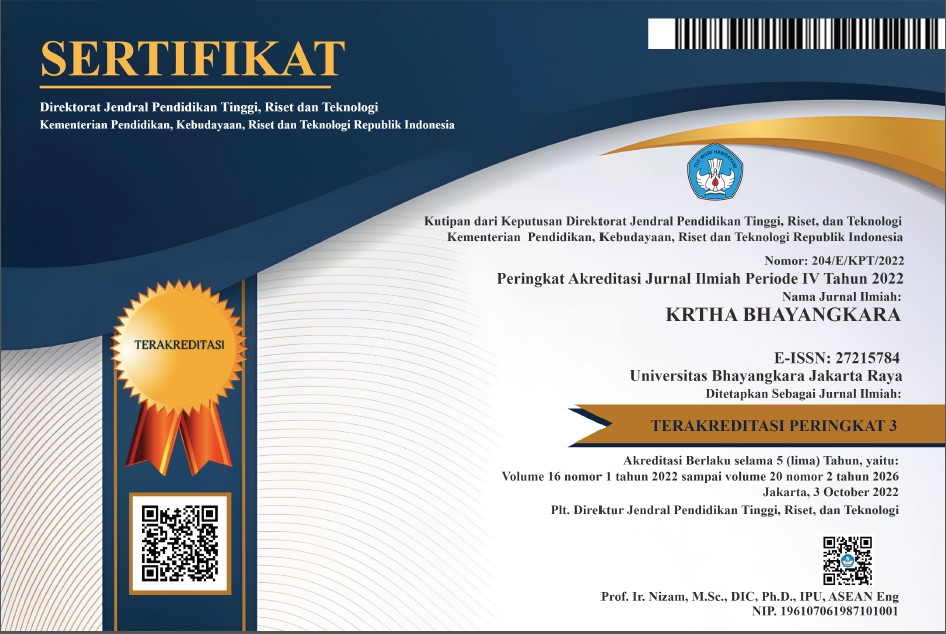


KRTHA BHAYANGKARA
Faculty of Law, Universitas
Bhayangkara Jakarta Raya
Jl. Raya Perjuangan , Marga Mulya, North
Bekasi, Bekasi City, Indonesia
Phone: (021) 7231948-7267655
Email
: krtha.bhayangkara@ubharajaya.ac.id

KRTHA
BHAYANGKARA is licensed under a Creative Commons Attribution 4.0 International License.