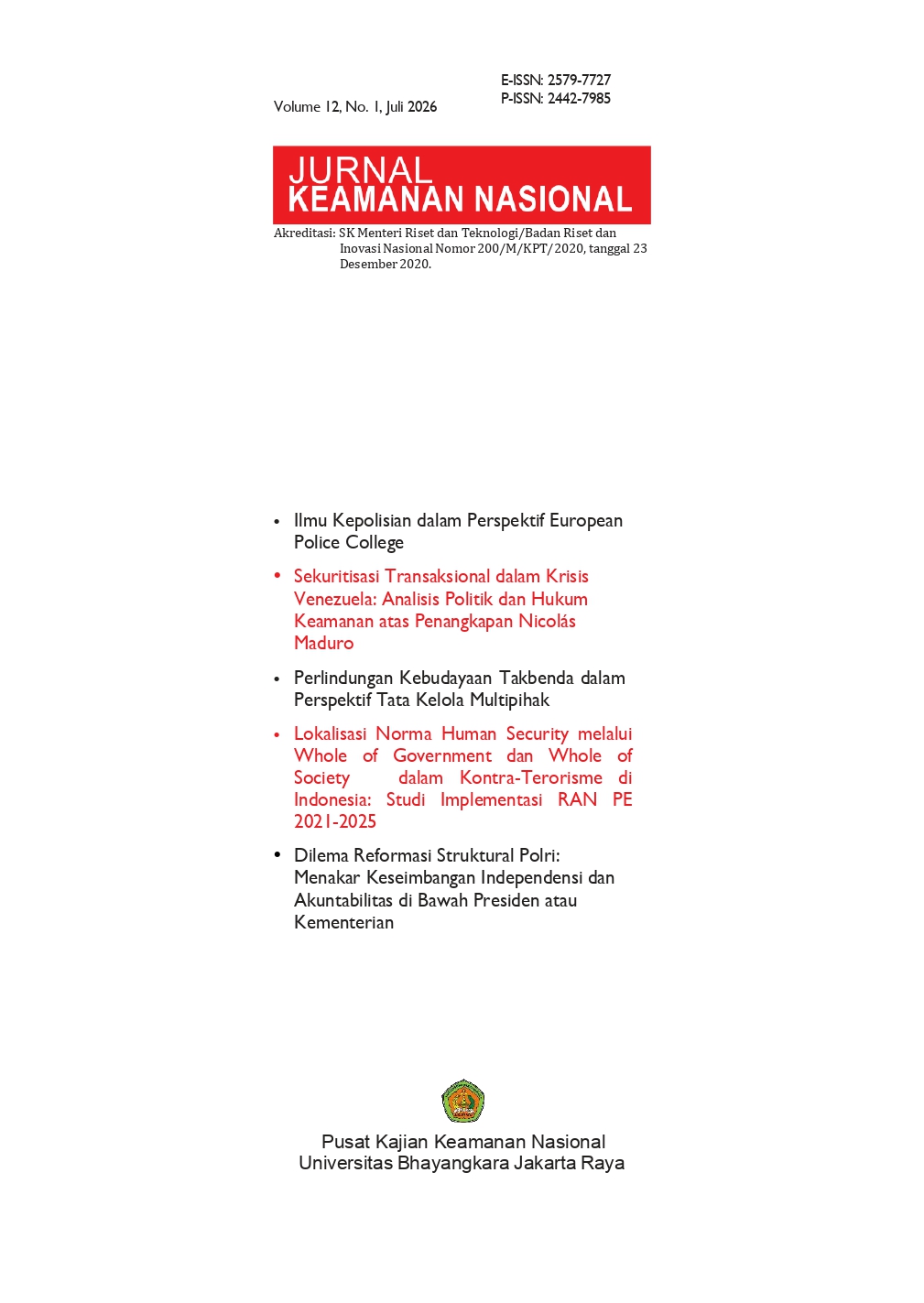
Dilema Reformasi Struktural Polri: Menakar Keseimbangan Independensi dan Akuntabilitas di Bawah Presiden atau Kementerian
DOI:
https://doi.org/10.31599/Keywords:
Police Reform; Accountability; Independence; Law Enforcement; Human Rights;Abstract
The placement of the Indonesian National Police (Polri) within the constitutional structure—directly under the President or under a ministry—remains a contested issue in Indonesia’s security-sector reform amid a persistent deficit in public trust and human rights protection. This article analyses the direction of police reform and weighs the constitutional consequences of both placement options. Employing a juridical-normative method with statutory, conceptual, case, and comparative approaches, this study examines primary and secondary legal materials, including Constitutional Court Decision No. 19/PUU-XXIII/2025. The study finds that the dichotomy of ‘under the President versus under a ministry’ is a false binary: the quality of democratic policing depends not on the structural locus but on the design of institutional safeguards: namely, guaranteed operational independence of investigation, legally empowered external oversight, and transparency. Comparative evidence from the United Kingdom, Japan, and France shows that police placed under a ministry can remain professional and democratic when such safeguards exist. The article recommends retaining Polri under the President while reconstructing the National Police Commission (Kompolnas) from an advisory body into an oversight body with binding ethical-investigative authority through amendment of Law No. 2 of 2002.
Downloads
Published
Issue
Section
License
Copyright (c) 2026 Edi Saputra Hasibuan (Author)

This work is licensed under a Creative Commons Attribution 4.0 International License.
Please read and understand the copyright terms for submissions to this journal.
Copyright Notice
The Jurnal Keamanan Nasional is under the Creative Commons Attribution 4.0 International (CC-BY 4.0) License, according to which:
1) Authors retain copyright and grant the journal the right to first publication, with the work simultaneously licensed under the Creative Commons Attribution (CC-BY 4.0) that allows the sharing of articles published with the acknowledgement of authorship and the initial publication in this journal.
2) The authors are authorized to make additional contracts separately for distribution of the version of the work published in this journal (for example, publication in an institutional repository or as a chapter of the book), as long as there is recognition of authorship and initial publication in this journal.
3) Authors are authorized and encouraged to publish and distribute their work online (for example, in institutional repositories or on their personal pages) at any time before or during the editorial process, as it increases the impact and reference of the published work.