


KRTHA BHAYANGKARA welcomes original, high-quality scholarly manuscripts that contribute significantly to the advancement of knowledge in Law and Security Studies. The journal provides an international academic platform for researchers, legal scholars, security experts, practitioners, and policymakers to critically examine the relationship between legal frameworks, security institutions, law enforcement, governance, and the protection of individual and collective rights. All submissions must align with the journal's Aims and Scope, demonstrate rigorous scholarly standards, and offer substantive theoretical, empirical, methodological, or policy contributions to the development of law and security studies at national, regional, and international levels.
KRTHA BHAYANGKARA considers the following manuscript categories:
Original Research Articles present findings from novel empirical, normative, or applied research addressing significant issues in law and security studies. These submissions must articulate clear research questions or objectives, establish a robust legal or theoretical foundation, employ appropriate and rigorous research methodologies, present systematic legal or empirical analysis, and formulate evidence-based conclusions.
Methodological Scope: Submissions may employ normative legal research, empirical legal research, socio-legal approaches, comparative legal research, historical legal research, security policy analysis, or mixed-methods approaches, provided that the selected methodology is appropriate and rigorously applied to the research questions.
Thematic Coverage: Articles may examine, but are not limited to, public law, private law, Islamic law, customary law, constitutional and administrative law, criminal law, international law, human rights, national security, human security, criminal justice systems, law enforcement, policing, terrorism and counterterrorism, cybercrime and cybersecurity, transnational crime, border security, environmental security, public order, intelligence and security governance, institutional accountability, and contemporary challenges involving law and security.
Expected Contribution: Manuscripts must demonstrate a clear and original contribution to legal and security scholarship by advancing relevant theories, providing critical legal or security analysis, addressing emerging threats and challenges, or developing new perspectives on existing legal and security frameworks. Where applicable, manuscripts should offer practical implications for legal reform, security policy development, law enforcement strategies, institutional governance, judicial practice, human rights protection, and the strengthening of justice and public security.
Theoretical and Conceptual Papers develop, critically examine, reinterpret, or synthesize theories, doctrines, principles, concepts, and analytical frameworks related to law and security studies. These manuscripts aim to advance scholarly discourse by examining established legal and security paradigms, identifying theoretical and conceptual limitations, developing alternative perspectives, or proposing innovative analytical frameworks to address contemporary legal and security challenges.
Academic Rigor: Submissions must demonstrate a strong theoretical, legal, and conceptual foundation, critical engagement with relevant contemporary literature, consistency in legal and analytical reasoning, and coherent and systematic argumentation.
Expected Contribution: Conceptual papers must extend beyond descriptive discussions of legal concepts, security issues, or narrative literature reviews. They must present original theoretical arguments, conceptual developments, critical interpretations, or innovative analytical frameworks that advance law and security studies and inform future research, legal reform, security policies, institutional governance, law enforcement, and the protection of human rights.
All manuscripts submitted to KRTHA BHAYANGKARA must comply with the following publication ethics and editorial requirements:
Originality and Exclusivity: Submissions must constitute original scholarly work that has not been previously published and is not simultaneously under consideration by another journal or publication.
Language and Formatting Standards: Manuscripts must be written in clear, formal, and academically appropriate English or Indonesian, in accordance with the journal's language policy, Author Guidelines, citation requirements, and official manuscript template.
Editorial Evaluation and Peer Review: All submissions undergo an initial editorial assessment and similarity screening. Manuscripts that meet the journal's preliminary requirements proceed to a double-anonymous peer-review process involving at least two independent reviewers with relevant expertise in law, security studies, or related interdisciplinary fields.
Publication Decision Criteria: Editorial decisions are based on the originality and significance of the legal or security issues examined, the strength of theoretical and conceptual foundations, the appropriateness of research methodology, the depth of legal and security analysis, the clarity of scholarly argumentation, and the relevance of the findings to the advancement of law and security studies and their practical applications.
 |
 |
 |
|
 |
 |
 |
 |
 |
 |
 |
 |
 |
 |
 |
 |

 |
 |
 |
 |




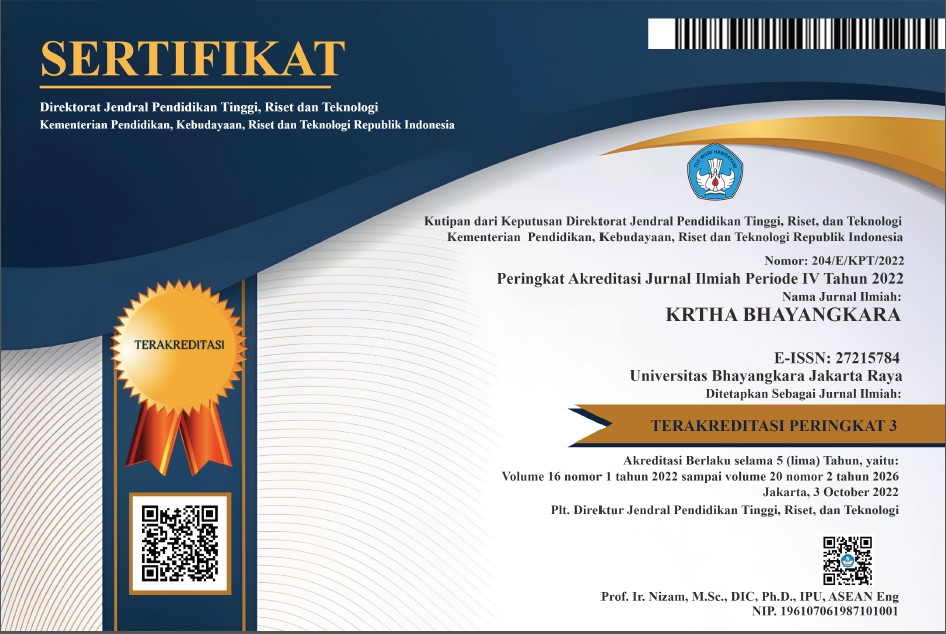
E-ISSN 2721-5784

P-ISSN 1978-8991


KRTHA BHAYANGKARA
Faculty of Law, Universitas
Bhayangkara Jakarta Raya
Jl. Raya Perjuangan , Marga Mulya, North
Bekasi, Bekasi City, Indonesia
Phone: (021) 7231948-7267655
Email
: krtha.bhayangkara@ubharajaya.ac.id

KRTHA
BHAYANGKARA is licensed under a Creative Commons Attribution 4.0 International License.