


KRTHA BHAYANGKARA encourages authors to promote research transparency, accountability, and reproducibility by providing access to relevant research data, materials, legal sources, and methodological information wherever possible.
The journal recognizes that data-sharing practices vary according to research methods and legal research traditions. Accordingly, this policy applies to normative legal research, empirical legal research, socio-legal studies, comparative legal research, historical legal research, and theoretical or conceptual studies.
Authors are responsible for ensuring that the sources, data, materials, and methods underlying their research are accurately reported and sufficiently described to enable readers to assess the validity, reliability, and scholarly contribution of the research.
Authors are encouraged to make relevant research data and supporting materials available through appropriate institutional repositories, recognized research data repositories, or other accessible platforms, wherever legally and ethically permissible.
Depending on the research methodology, relevant materials may include:
Research instruments, questionnaires, and interview guidelines.
Anonymized interview transcripts and survey datasets.
Data collection and analysis procedures.
Supporting documents, tables, and research materials.
Legislation, court decisions, and other authoritative legal sources.
Research protocols, analytical frameworks, and supplementary materials.
For normative legal research, authors should provide sufficient bibliographic and legal references to enable readers to identify and independently verify the legislation, judicial decisions, legal doctrines, and other legal materials used in the analysis.
For empirical and socio-legal research, authors are encouraged to provide access to relevant datasets and research instruments, subject to applicable ethical, legal, and confidentiality requirements.
Authors are required to include a Data Availability Statement in their manuscripts before the References section.
The statement must explain whether the data or materials supporting the research findings are publicly available, available upon reasonable request, or subject to restrictions.
Authors may use the following examples, depending on the circumstances:
A. Data publicly available
"The data supporting the findings of this study are publicly available at [repository name and URL or DOI]."
B. Data available upon reasonable request
"The data supporting the findings of this study are available from the corresponding author upon reasonable request, subject to applicable ethical and legal restrictions."
C. Data subject to confidentiality or legal restrictions
"The data supporting the findings of this study are not publicly available due to confidentiality, privacy, and legal restrictions. Access to the relevant materials may be considered subject to appropriate authorization and applicable legal requirements."
D. Normative legal research
"This study is based on publicly available legal materials, including legislation, court decisions, legal doctrines, and scholarly publications. The sources used in this research are identified and cited in the manuscript."
E. No separate dataset generated
"No new datasets were generated or analyzed during this study. The research is based on the analysis of existing legal materials and scholarly literature cited in the manuscript."
Authors must select the statement that accurately reflects the nature of their research and the actual availability of the supporting materials.
Authors must ensure that research data and supporting materials are shared in accordance with applicable ethical standards, confidentiality obligations, intellectual property rights, and national and international data protection requirements.
Data involving personal information, confidential interviews, court records, criminal investigation documents, protected witnesses, victims, children, or other vulnerable individuals must not be disclosed without an appropriate legal and ethical basis.
Where data sharing is restricted by informed consent conditions, institutional requirements, court orders, statutory provisions, or other legitimate legal obligations, authors must clearly explain the restrictions in their Data Availability Statement.
Anonymization or removal of identifying information should be undertaken where appropriate to protect the rights and interests of individuals involved in the research.
Authors conducting legal research must ensure that all cited legal materials are authentic, accurate, and traceable.
Legislation, judicial decisions, court documents, legal doctrines, and other authoritative materials must be identified through sufficient bibliographic information or official sources wherever available.
Authors must provide clear explanations of their legal research approaches, analytical frameworks, selection of legal materials, and interpretation procedures to enable readers to evaluate the reasoning and findings.
For empirical and socio-legal research, authors should provide sufficient methodological details concerning research design, sampling procedures, data collection, and analysis to support the assessment and potential replication of the research, where appropriate.
KRTHA BHAYANGKARA may request relevant research data, original materials, legal sources, research instruments, or supporting documentation when necessary to assess the accuracy, validity, and reliability of a submitted manuscript or published article.
Authors are expected to cooperate with reasonable editorial requests and provide relevant materials, subject to applicable ethical, legal, confidentiality, and data protection requirements.
Where authors cannot provide requested materials, they must explain the reasons and provide alternative supporting information where possible.
The journal may seek independent expert advice or take appropriate editorial action if substantial concerns regarding data authenticity, legal source accuracy, or research integrity remain unresolved.
KRTHA BHAYANGKARA recognizes that responsible data sharing strengthens scholarly transparency, facilitates independent verification, and supports the advancement of legal knowledge.
Data sharing is encouraged wherever appropriate but must not compromise research participants' rights, confidentiality, legal obligations, or intellectual property protections.
This policy should be read in conjunction with the journal's Ethical Oversight Policy, Allegations of Research Misconduct Policy, Publication Ethics and Malpractice Statement, and other relevant editorial policies.
 |
 |
 |
|
 |
 |
 |
 |
 |
 |
 |
 |
 |
 |
 |
 |

 |
 |
 |
 |


E-ISSN 2721-5784

P-ISSN 1978-8991
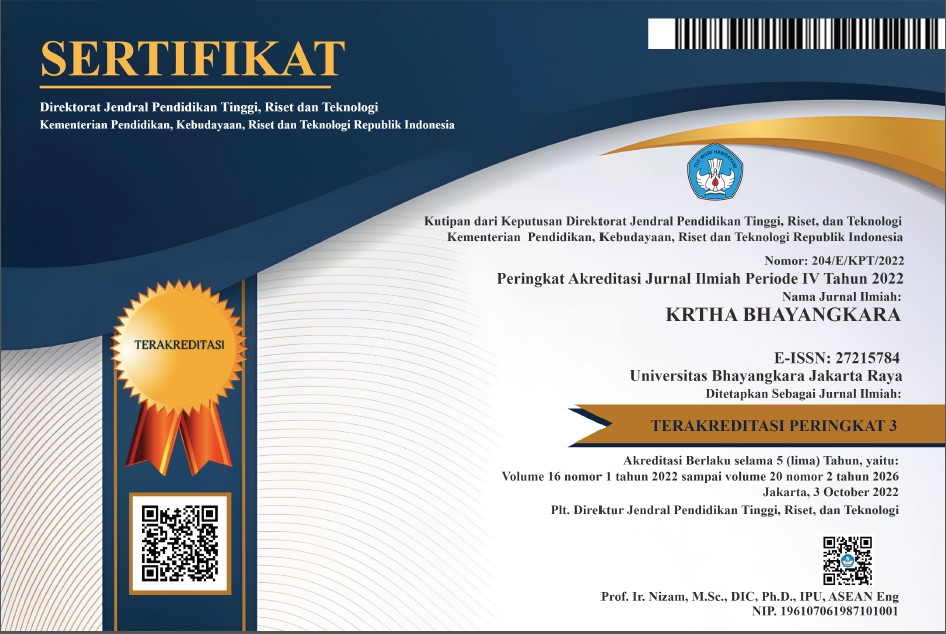


KRTHA BHAYANGKARA
Faculty of Law, Universitas
Bhayangkara Jakarta Raya
Jl. Raya Perjuangan , Marga Mulya, North
Bekasi, Bekasi City, Indonesia
Phone: (021) 7231948-7267655
Email
: krtha.bhayangkara@ubharajaya.ac.id

KRTHA
BHAYANGKARA is licensed under a Creative Commons Attribution 4.0 International License.