

KRTHA BHAYANGKARA is committed to handling complaints and appeals fairly, transparently, objectively, and confidentially, in accordance with its publication ethics policies and relevant guidance from the Committee on Publication Ethics (COPE).
This policy provides a formal mechanism for authors, reviewers, editors, readers, and other relevant parties to raise concerns regarding the journal's editorial management, peer-review process, publication practices, and editorial decisions.
KRTHA BHAYANGKARA welcomes legitimate complaints concerning its editorial management, peer-review procedures, publication practices, journal policies, or the conduct of editors, reviewers, and journal staff.
Complaints may include, but are not limited to:
Unreasonable delays in manuscript processing or editorial communication.
Alleged violations of publication ethics or research integrity.
Breaches of confidentiality during the submission or peer-review process.
Undisclosed conflicts of interest involving authors, editors, or reviewers.
Unfair or inappropriate editorial or peer-review practices.
Alleged discrimination, inappropriate conduct, or misuse of editorial authority.
Concerns regarding the accuracy, transparency, or integrity of published articles.
Complaints must be submitted in writing to the KRTHA BHAYANGKARA Editorial Office through the official contact information provided on the journal website. The complaint should clearly describe the concern and include relevant supporting information or evidence, where available.
The journal will assess each complaint objectively and take appropriate action based on its nature and seriousness. Wherever practicable, complaints will be handled by an editor or representative who is not directly involved in the matter.
Where a complaint involves potential research misconduct, publication ethics violations, or concerns that cannot be adequately resolved internally, the journal may seek independent expert advice or refer the matter to the relevant institution or appropriate authority.
Authors may appeal an editorial decision if they have substantive grounds to believe that the decision involved a significant factual or technical error, a material misunderstanding of the manuscript, a procedural irregularity, or an undisclosed conflict of interest.
Appeals must be submitted in writing to the Editor-in-Chief through the Editorial Office. The appeal should identify the manuscript and clearly explain the grounds for reconsideration, addressing the relevant editorial or reviewer comments and providing supporting evidence or additional information where applicable.
Disagreement with an editorial decision alone, without substantive supporting grounds, is not sufficient for an appeal. An appeal does not guarantee that the original decision will be reversed or that the manuscript will be accepted.
The Editor-in-Chief will assess the appeal and may consult an independent editor who was not involved in the original decision or seek additional expert advice, where appropriate.
If the appeal concerns the Editor-in-Chief or involves a relevant conflict of interest, it will be referred to an appropriately designated independent representative of the publisher or institutional management.
Following assessment, KRTHA BHAYANGKARA may:
Uphold the original editorial decision.
Reconsider the manuscript based on the additional evidence or identified procedural concerns.
Request an additional independent peer review.
Take other appropriate editorial action based on the circumstances.
The journal normally considers one appeal per manuscript. The decision following the appeal assessment is final within the journal's internal editorial process.
Complaints and appeals will be handled with appropriate confidentiality. Information will be shared only with individuals or institutions who need access to assess or resolve the matter, subject to applicable legal and ethical obligations.
Any editor, reviewer, or other person involved in handling a complaint or appeal who has an actual or potential conflict of interest must disclose it and refrain from participating in the assessment.
Where necessary, an independent editor or appropriately designated representative of the publisher will be appointed to ensure an impartial process.
KRTHA BHAYANGKARA does not tolerate retaliation against individuals who raise legitimate complaints or appeals in good faith.
KRTHA BHAYANGKARA aims to acknowledge complaints and appeals promptly and address them within a reasonable period, taking into account the complexity of the matter, the availability of supporting evidence, and the need for further investigation.
The journal will communicate the outcome to the relevant parties, subject to confidentiality requirements.
Where necessary, the journal may consult independent experts, the publisher, the relevant institution, or other appropriate authorities to ensure that concerns are handled properly and that publication ethics and the integrity of the scholarly record are protected.
If a complaint or appeal identifies a substantive error or ethical concern in an already published article, the journal will assess the matter in accordance with its Corrections, Retractions, and Expressions of Concern Policy.
All complaints and appeals must be assessed independently of personal, institutional, financial, or professional interests.
The journal's publisher supports the fair administration of complaint and appeal procedures but does not improperly interfere with editorial assessments or the resolution of scholarly disputes.
Editorial decisions concerning complaints and appeals must be based on available evidence, applicable journal policies, and recognized publication ethics principles.
This policy should be read in conjunction with the other relevant policies of KRTHA BHAYANGKARA, including:
Publication Ethics and Malpractice Statement.
Peer Review Process.
Allegations of Research Misconduct Policy.
Conflict of Interest Policy.
Authorship and Contributorship Policy.
Corrections, Retractions, and Expressions of Concern Policy.
Use of Generative AI Policy.
KRTHA BHAYANGKARA is committed to ensuring that all complaints and appeals are handled fairly, consistently, and transparently to maintain trust in the journal's editorial processes and the integrity of scholarly publishing.
 |
 |
 |
|
 |
 |
 |
 |
 |
 |
 |
 |
 |
 |
 |
 |

 |
 |
 |
 |




E-ISSN 2721-5784

P-ISSN 1978-8991
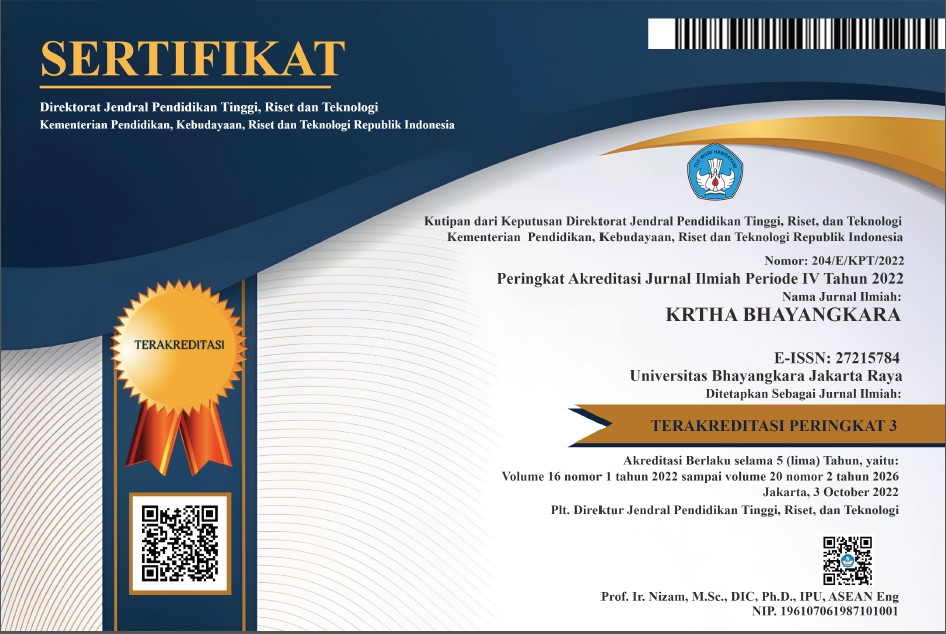


KRTHA BHAYANGKARA
Faculty of Law, Universitas
Bhayangkara Jakarta Raya
Jl. Raya Perjuangan , Marga Mulya, North
Bekasi, Bekasi City, Indonesia
Phone: (021) 7231948-7267655
Email
: krtha.bhayangkara@ubharajaya.ac.id

KRTHA
BHAYANGKARA is licensed under a Creative Commons Attribution 4.0 International License.